






Breaking the rock barrier requires more than just a standard radio. It demands a specialized underground communication system designed for high attenuation and extreme safety risks. This guide explores why a professional mining walkie talkie is the ultimate lifeline for the depths.
The Physics of Underground Communication: Overcoming Obstacles
Radio waves behave differently when surrounded by solid granite, soil, or reinforced concrete. Standard signals are absorbed or scattered quickly.
Signal Attenuation: Why Rocks Block Everything
Solid rock is a massive barrier to radio frequency (RF) energy. In a vertical shaft or a long tunnel, your signal loses strength exponentially with distance. To maintain a clear underground communication system, you need high-power devices with superior receiver sensitivity.
Choosing UHF for Superior Tunnel Signal Reflection
While VHF is great for open fields, UHF is usually the better choice for tunneling communication. UHF's shorter wavelengths act like a rubber ball, bouncing off the hard walls of the tunnel. This "waveguide" effect allows the signal to travel further around bends and through narrow passages where VHF would simply be absorbed.
Safety in Volatile Zones: The Role of Intrinsically Safe Radio
In many mines and chemical tunnels, the air is thick with danger. Methane gas and combustible dust can turn a tiny electrical spark into a massive explosion.
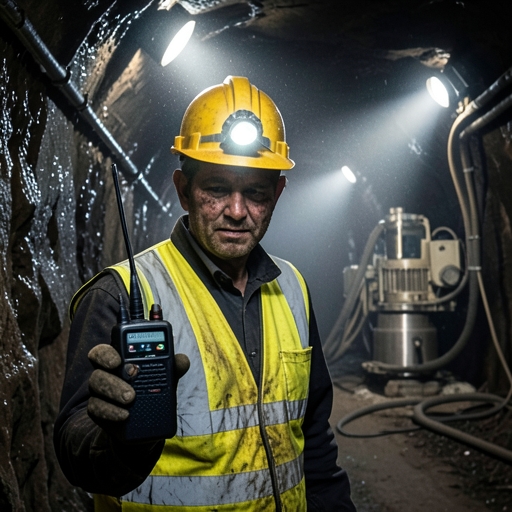
Methane and Coal Dust: The Case for Explosion-Proof Gear
You cannot use a standard consumer radio in these environments. You must equip your team with an . These devices are engineered to limit electrical and thermal energy. This prevents any internal fault from generating a spark or heat level capable of igniting the atmosphere.
Understanding Hazardous Location Radio Certifications for Mines
Always look for international certifications like ATEX or IECEx. For mining, the "Group I" category is specifically for methane-rich environments. The Chierda TC328D is a prime example of a hazardous location radio that meets strict safety standards while providing the clarity of digital DMR technology.
Surviving the Underground Environment: Durability Standards
Underground work is dirty, wet, and physically punishing on equipment.
IP67 Waterproof & Dustproof: High humidity and constant dripping water are common. An IP67-rated radio can handle mud and even brief submersion in mine puddles without failing.
Anti-Magnetic Speakers: Mining often involves metallic dust and iron ore. Chierda radios feature specialized anti-magnetic speakers. These prevent metallic particles from sticking to the speaker grill and ruining the audio quality over time.
Coverage Strategies for Tunneling Communication
For tunnels stretching several kilometers, a radio-to-radio signal is not enough. You need a structured network.
Deploying Underground Communication System with Repeaters
The most effective solution is a "Leaky Feeder" system or a chain of linked . A series of repeaters installed along the tunnel roof can receive and re-transmit signals. This effectively pushes the communication range deep into the excavation site.
Audio Clarity: Cutting Through Ventilation and Drilling Noise
Underground sites are deafening. Ventilation fans and heavy drills create constant white noise. Digital DMR radios use vocoders to isolate the human voice. This ensures that a critical safety alert is never lost in the background roar.
Conclusion: Reliable Comms: The Ultimate Safety Protocol for the Underground
In the deep, communication is the only thing standing between a controlled operation and a crisis. A mining walkie talkie system is not an optional accessory; it is a vital safety protocol. By investing in high-penetration hardware and intrinsically safe designs, you protect your most valuable asset: your people.
FAQ: Underground Technical Logistics
Can radios communicate through solid granite or concrete? Radio waves do not penetrate deep into solid rock. Communication primarily relies on signals reflecting down the tunnel path or through specialized underground infrastructure like leaky feeder cables or repeaters.
How do we charge radios in a remote mining base camp? For remote sites, we recommend multi-unit chargers powered by a stable generator or a solar-battery setup. Always ensure the charging area is in a "safe zone" away from any hazardous gases.
What is the most durable headset for a jackhammer operator? For high-vibration tasks, we recommend heavy-duty, dual-muff headsets. These provide hearing protection while allowing the worker to hear incoming transmissions clearly directly in their ear.
Is there a way to track the location of miners underground? While GPS doesn't work deep underground, some modern