
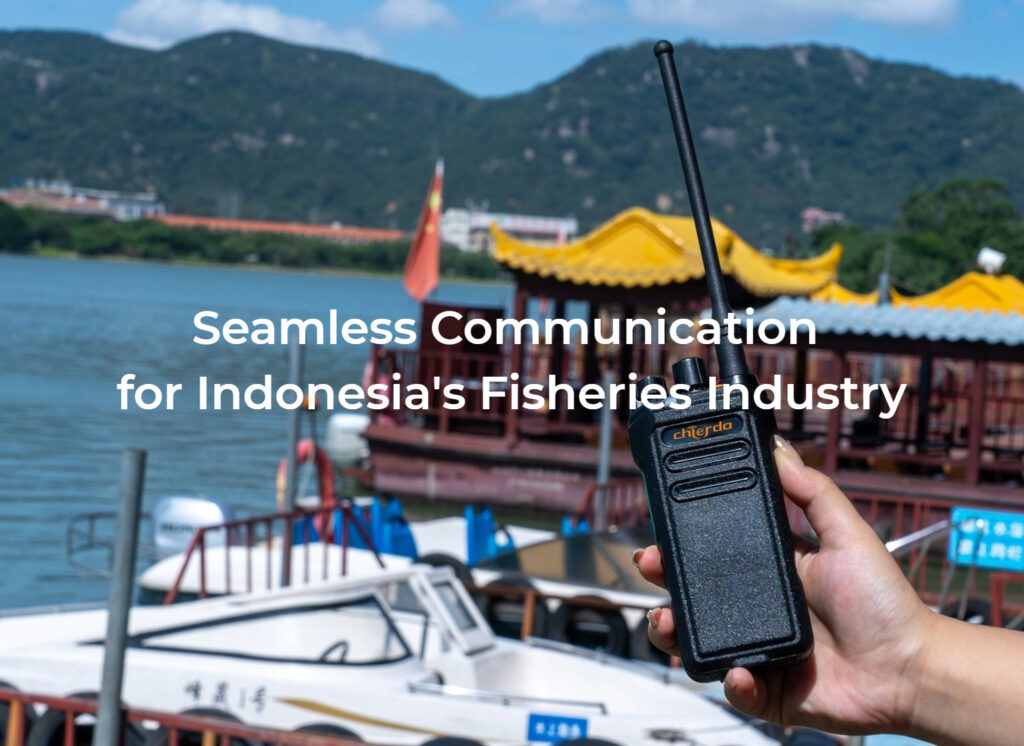
Indonesia, the world’s second-largest fisheries producer, is home to over 2.7 million fishermen and contributes more than USD 27 billion annually to its economy through marine and inland fisheries. With over 17,000 islands and vast coastal waters, fishing industry supports millions of jobs in Indonesia. At sea, anything can happen at a moment’s notice. It is very important to maintain communication to ensure safety.
However, working in offshore or nearshore environments presents major communication hurdles. Mobile signals are often unavailable at sea, and unpredictable weather and mechanical issues demand immediate coordination among fishing crews, processing units, and port authorities. That’s why two-way radios for fisheries are becoming an indispensable tool for modernizing Indonesia’s marine operations.
Why Fisheries Require Two-Way Radios for Seamless Communication?
- Overcoming Marine Communication Gaps
Out on the ocean, quick decision-making can be the difference between safety and danger. Traditional communication methods like mobile phones are unreliable in open waters, where signal loss is common. Two-way radios for fishing boats offer real-time, push-to-talk communication that does not rely on cellular networks, ensuring your crew stays connected from the dock to deep-sea zones.
- Deliver Clear Audio
Fishing vessels are noisy—engines, waves, and onboard machinery can drown out important instructions. Noise-canceling walkie talkies with high power speaker are essential for fisheries. Crews can give and receive instructions clearly without miscommunication, increasing safety and efficiency.
Key Features of Two-Way Radios for Indonesia’s Fisheries Industry
- Water resistant
Fishing environments expose devices to saltwater, rain, and splashes. Look for radios rated IP67 or higher, meaning they are fully waterproof and can even survive temporary immersion(≥30mins) in water.
- Long-range Communication
Given the wide areas fishing boats travel, long-range two-way radios with VHF/UHF dual-band options are ideal. These ensure stable communication over 10-30 km—even more when paired with a marine repeater system.
- Rugged and Floatable Build
Accidents happen. Radios that float and remain functional after drops are lifesavers. Especially those who have reinforced casings protect against shocks, heat, and corrosion from salty air can have a long-term service life.
- Long Battery Life
Extended fishing trips require battery life that lasts 12-20 hours or longer. Radios with large-capacity batteries or battery-saving modes ensure continued use without needing constant charging.
Chierda Water Resistant Handy Talkie for Reliable Communication
Chierda TC368plus high-performance walkie talkie is engineered for uncompromising reliability in tough environments, especially in coastal waters. Powered by 10W high power, it delivers a communication range of up to 10km, ensuring seamless connectivity even over long distances.
With an IP67 rating, it’s fully waterproof and dustproof, standing strong against heavy rain, splashes, and debris—ideal for outdoor, industrial, or marine use.
It is also repeater-capable. For using in extended work area, you can set up a repeater and connect TC368plus to reach further. On top lies an emergency SOS button. By pressing, it sends instant alerts—locally or remotely—to teammates, enhancing safety in emergencies. Push-to-talk is easy for every user. It also has flexible call modes, individual/group/all calls, to simplify communication.
Last but not least, it is SDPPI certified, which can be used legally in Indonesia.

Conclusion
As Indonesia continues to invest in its blue economy, ensuring reliable communication in fisheries will be central to progress. From small-scale coastal fishing fleets to large industrial fishing vessels, the right two-way radio system improves team coordination, boosts productivity, and enhances safety on every voyage.
It’s time to equip your fleet with robust, long-range, waterproof two-way radios—and experience the difference that seamless communication makes on the high seas.