
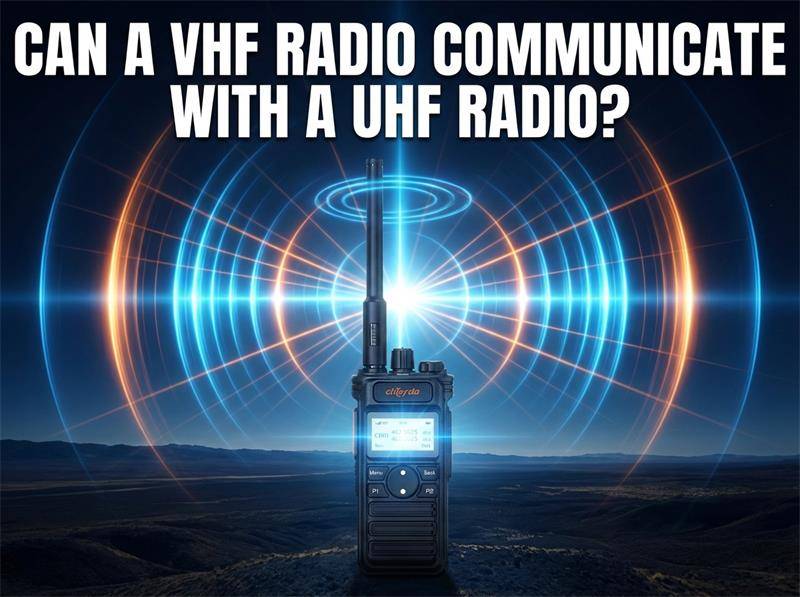
If you work in industries like construction, security or outdoor event management, you’ve probably come across both VHF radios and UHF radios. Can a VHF radio can communicate with a UHF radio directly? The short answer is no, not without assistance.
Understanding the differences between UHF and VHF radios is key to choosing the right device to improve efficiency. We will explore why VHF and UHF radios are not inherently compatible, the reasons behind the frequency gap, and how you can bridge this divide with the right solutions.
Difference Between VHF and UHF Radios
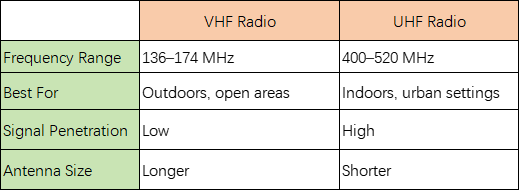
VHF (Very High Frequency) radios which we frequently use operate in the 136-174 MHz range. These radios are ideal for open outdoor areas with few obstructions, such as farms, marinas, or open fields. VHF signals tend to travel farther but struggle when penetrating solid barriers like buildings or dense forests.
UHF (Ultra High Frequency) radios operate in the 400-520 MHz range or much narrower. These are better suited for urban or indoor environments due to their strong penetration capabilities. UHF radios can pass through concrete, steel, and walls more effectively than VHF radios, making them perfect for construction sites, warehouses, and hospitality spaces.
Why VHF and UHF Radios Can’t Talk to Each Other
Normally speaking, a VHF radio can’t communicate with a UHF radio directly. VHF and UHF radios operate on different frequency bands, they cannot communicate directly unless both radios are dual-band compatible or a radio repeater is used.
When people ask, “Can a VHF radio communicate with a UHF radio?”, the answer depends on the equipment. Standard single-band radios lack the hardware to switch frequencies or transmit signals across bands.
Even two way radios of the same model sometimes may fail to communicate. Do you know why?
It’s because these walkie-talkies are set up with frequencies and channels at the factory. For example, this walkie-talkie has 1-16 channels. It was preset all the frequencies at the factory, which is different from another walkie-talkie. Then the two radios do not talk to each other if you can’t program and rewrite the frequency. In addition, make sure the two walkie talkies have the same CTCSS/DCS, otherwise they can not communicate.
Nowadays, many walkie-talkies have one-key frequency pairing function, such as Chierda TC318 rugged two way radios. You can follow the process and quickly pair the frequency between two walkie talkies.
How to Bridge the Gap Between VHF and UHF Radios
- Use a Dual-Band Two-Way Radio
Some advanced two-way radios offer dual-band capabilities, meaning they can transmit and receive on both VHF and UHF frequencies. If seamless cross-band communication is critical, invest in dual-band radios for your team.
- Install a Cross-Band Repeater
For larger operations like event venues or industrial facilities, a cross-band repeater is a smart solution. It can receive a signal on one frequency (VHF) and retransmit it on another (such as UHF), enabling communication between different types of radios.