
Many dual-band amateur radios on the market advertise their ability to receive the air band. For Ham radio beginners, it is confusing to know what the air band is. While Is it legal to listen to the air band? Today we will delve into this question together.
In aviation, communication between pilots and air traffic controllers(ATC) is crucial for safety, efficiency, and smooth operations. If you’ve ever watched aviation-themed movies or documentaries, you’ll notice the captain communicating with the control tower before takeoff and landing. This is the Aviation frequency bands. They communicate on designated radio frequencies to keep airport operations running smoothly and safely. Aircraft frequencies play a vital role in this communication. Many aviation enthusiasts and hobbyists use radios to receive aircraft frequencies to hear the communication between ATC and pilots.
What are Aircraft Frequencies?
Aircraft frequencies refer to the radio channels used for communication between aircraft and various aviation authorities, including air traffic control towers (ATC), ground control, and other aircraft in the vicinity. These frequencies are assigned by the Federal Communications Commission (FCC) in the United States or other relevant authorities globally. The primary purpose of these frequencies is to ensure clear, uninterrupted communication that helps maintain flight safety, navigation, and coordination between various parties in the aviation ecosystem.
Classification of Aviation Frequencies
Aviation frequency bands are strictly divided and managed by the International Telecommunication Union (ITU) and the International Civil Aviation Organization (ICAO) to ensure the consistency and safety of global aviation communications. According to different uses, aviation frequencies can be broadly categorized as follows:
Aviation mobile service frequencies: mainly used for voice communications and data transmission between aircraft and ground control stations, and between aircraft and aircraft, such as Very High Frequency (VHF) communications, which cover a limited distance but are sufficient to meet the communication needs of most routes.
Aviation navigation frequencies: include frequencies used for radio navigation, such as Global Positioning System (GPS) signal reception, as well as frequencies used by traditional radio navigation equipment, such as Distance Measuring Instrument (DME) and Omni-directional Beacon (VOR).
Aviation Weather Frequency: Used to transmit weather information to help pilots understand the weather conditions along the flight path and make safe flight decisions.
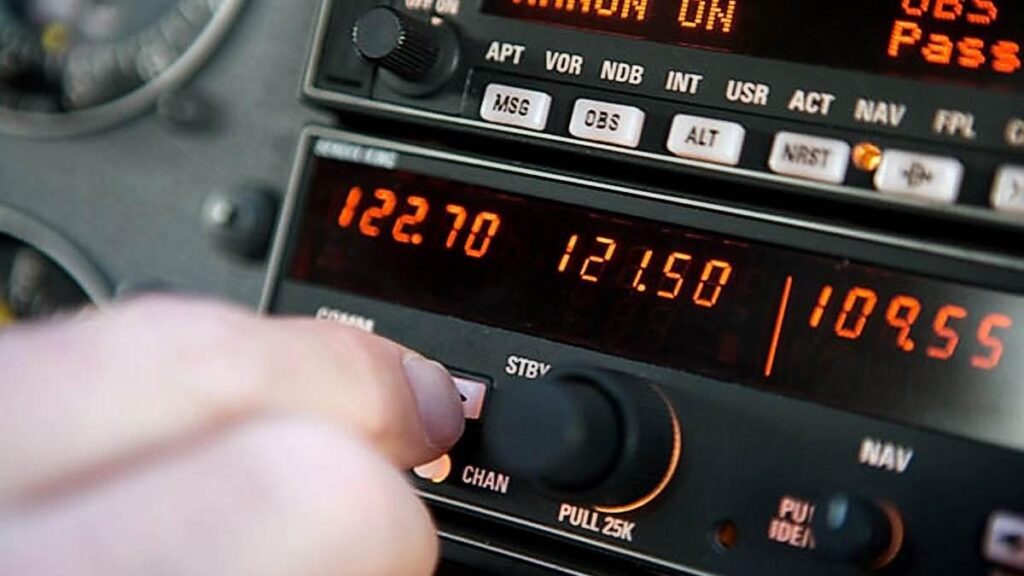
Emergency Frequency: Designed for emergencies, such as 121.5MHz and 243MHz, it is used for transmitting distress signals when the airplane is in distress, and is the guardian line of life in the air.
Basic Aircraft Frequencies
121.5 is the emergency frequency. If there is some sort of emergency, pilots will transmit on it. You could also hear an emergency locator beacon on this frequency if a plane crashes.
122.750 MHz is the frequency for general aviation air to air communications.
123.025 MHz is the frequency for helicopters air to air communications.
123.450 MHz is the “unofficial” frequency for air to air communications.
122.0-123.65 for Unicom (uncontrolled airports) and air to air communications.
128.825-132.000 MHz for ARINC frequencies (airlines, corporate aviation and general aviation calling ahead for fuel, parking, and other requests).
If you want to learn more aircraft frequencies, you can fount at here.

FAQ
Q1: Is it legal to use handheld radios to listen to aviation frequencies?
You can use two way radios to receive aircraft frequencies if your radios allow. Just be courteous with it and don’t use the device to either interfere with ATC communications or for personal conversations with ATC or aircrews.